
We Built Our Own Technology. Here Is What It Does for You.
The Technology Behind the 17-Day Cycle Time
Most renovation contractors manage jobs the same way they did 20 years ago. Spreadsheets. Phone calls. A project manager who finds out about a delay when a subcontractor does not show up.
That model works well enough when you are managing one building at a time. It breaks down when you are managing hundreds of units across multiple buildings simultaneously, which is exactly the environment that institutional multifamily renovation requires.
URC built a different system.
What our proprietary technology does
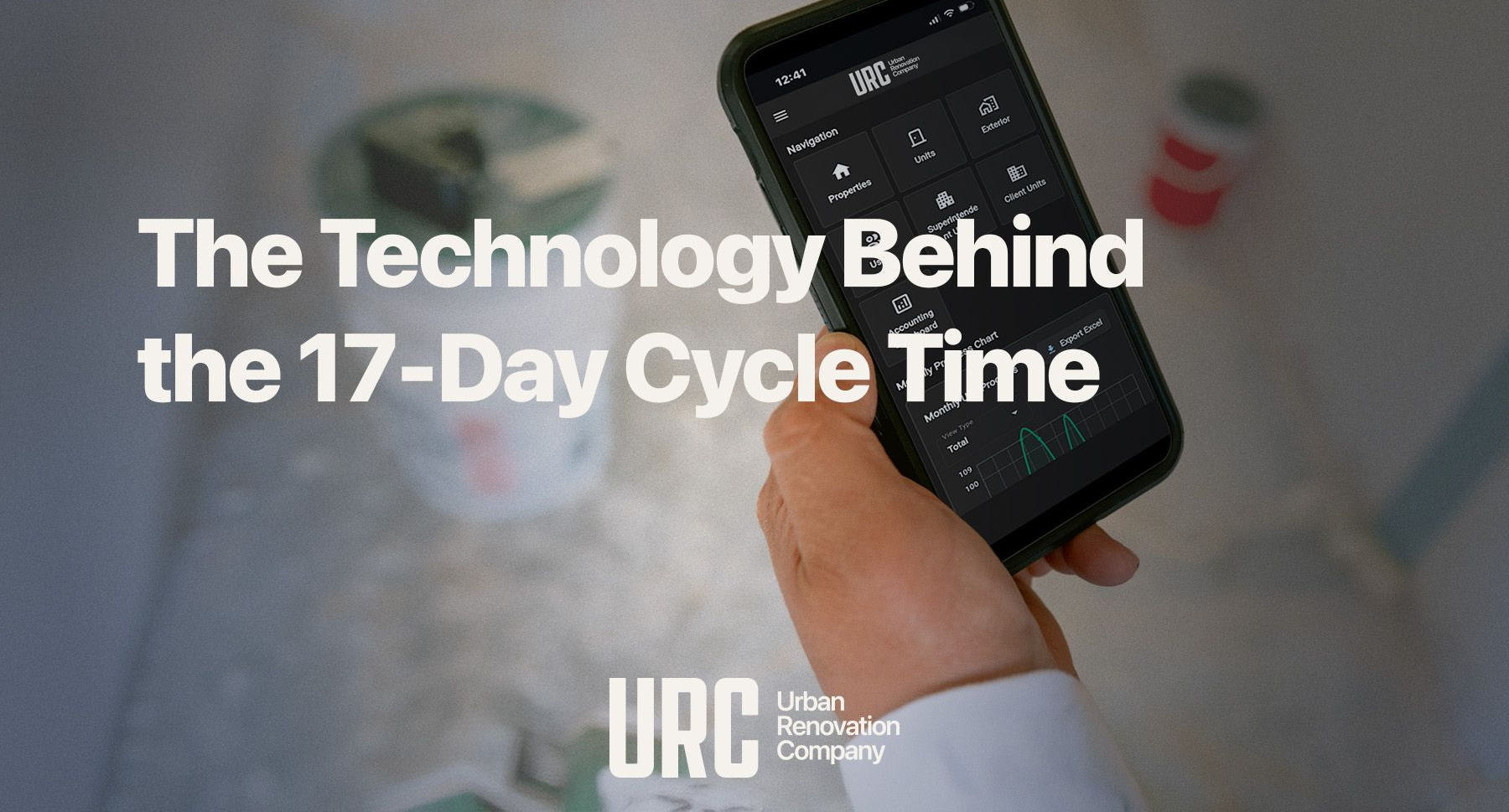
Several years ago, URC developed an internal tracking platform built specifically for the demands of multi-unit renovation at scale. It was not built to look innovative. It was built because the operational problem it solves, managing cycle time across dozens of concurrent unit renovations, was too important to leave to instinct and reactive communication.
The platform tracks every unit in a renovation program in real time. It monitors where each unit is in the renovation sequence, flags delays before they compound into schedule problems, manages subcontractor performance against defined benchmarks, and generates the performance data that allows our project managers to forecast cycle times with accuracy and report progress to ownership with confidence.
The result is a renovation program that runs on a schedule the property owner can plan around, not one they have to manage around.
Why cycle time is a financial metric, not just an operational one
Every day a unit sits offline costs the owner money. Deferred rental income. Extended carrying costs. Delayed NOI recovery. At a conservative estimate of $100 per day in deferred income, the difference between a 30-day industry average cycle time and URC's 17-day average is 13 days recovered per unit.
Across a 100-unit program, that is $130,000 in restored rental income. Across a 1,000-unit portfolio, it is $1.3 million annually. Not from a renovation that costs more. From one that finishes faster.
That math is only possible because the technology exists to manage it consistently. Without real-time unit-level tracking, cycle time improvement is anecdotal. With it, it is measurable, reportable, and repeatable.
What this means for institutional owners
Institutional operators increasingly expect data from their renovation partners. Not just a completion date, but visibility into the program while it is running. The ability to know on any given day how many units are on schedule, how many are at risk, and what the projected completion date looks like based on current performance.
URC's platform provides that visibility. Our clients do not have to chase the job. They receive regular reporting built on real data from the field, not a project manager's best estimate.
A platform that keeps improving
URC's technology was built internally and is owned entirely by our leadership. That means it evolves with the company. As we enter new markets and take on larger programs, the platform scales with us. And as institutional client expectations around data and transparency continue to rise, we are already positioned to meet them.
No contractor in the multi-unit renovation space has built what URC has built. That gap is not closing on its own.